President Trump appeared to stick meticulously to the script for his first State of the Union Address, outlining both his accomplishments and the strength of the American people. Unfortunately, many Democrats conspicuously failed to applaud rising wages, low unemployment, record low minority unemployment, low prescription prices, and a high stock market. Although other Democrats immediately took to the airwaves peddling their identity politics as usual, they conspicuously ignored a small but important part of Trump agenda going forward: prison reform. The United States has one of the highest per capita incarceration rates in the world, at a cost of $74 billion per year. True fiscal conservatives like President Trump and Florida Governor Scott have now gone on record supporting reforms to our penal system to ensure that incarceration serves the rehabilitative ends to which it is directed.
Blog
Gerrymander Queen Reports to Prison
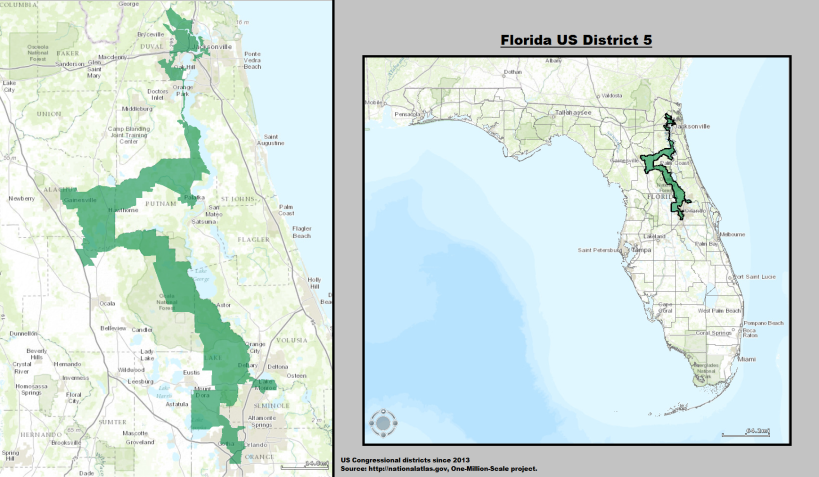
Congresswoman Corrine Brown was the queen of the Gerrymander. Brown’s seat once stretched over eight counties and weaved back and forth across the St. John’s river, from Jacksonville to Orlando. After years of litigation by Brown, the Democratic Party, and others, the district was recently corrected, but not before Brown found herself in further legal controversy.
Brown, it turned out, was as crooked as her district. The former Congresswoman stole more than $800,000 from a charity she managed. After a trial, conviction, sentencing, and pleas at the trial and appellate level for a deferred surrender pending appeal, Brown was ordered to report to federal prison today to begin serving a five-year sentence for tax fraud and corruption.
Brown’s misconduct that landed her in prison is particularly regrettable because she risked something scarce – five healthy years at the age of 71 – for money, which she should have had enough of after nearly a quarter century collecting a six-figure taxpayer-funded salary. Neither Brown nor her district will befoul Florida politics ever again.
Attorney Michael Beltran Moderates Alafia Judicial Candidates Forum
On January 8, 2018, Attorney Michael Beltran moderated the Alafia Judicial Candidates Forum. All eight lawyers from all three contested races in Hillsborough County attended. After an introduction to the judiciary by Michael Beltran, shown below, candidates spoke about their legal background, judicial philosophy, trial experience, and how they would handle difficult cases. The room was packed. Many thanks to all who attended!
The FBI Texting Scandal and the Use of Stored Communications in Legal Controversies
I recently posted about persons who foolishly speak to FBI agents without first retaining counsel, and am unsurprised to discover that FBI agents themselves say some really stupid things. An FBI official’s texts with his mistress about the Trump investigation revealed his improper motives for investigating General Flynn and led to the revelation that he revised a report about the Clinton email scandal. An FBI employee conducting an affair is emphatically unfit to be working on one of the most sensitive “counterintelligence” investigations in history. Intelligence agencies regularly polygraph their employees to ascertain whether substance abuse, financial difficulties, or illicit personal behavior might allow them to be blackmailed or corrupted in the execution of their official duties. Some people say stupid things in texts. Some people conduct clandestine affairs in the workplace. Others engage in partisan witchhunts. Few people can do all three while also serving as a top counterintelligence official and sending more than 10,000 text messages.
Even in the electronic age, texts are a cumbersome method of conducting serious business. (And while high-ranking FBI officials exchange 10,000 texts, the “investigation” drags on.) However, texts, social media posts, and even personal emails are valuable to show bias, alibi, impeachment, tendencies, unknown connections, and even personality traits that might be relevant to an investigation or legal controversy. In the information age, matters that were previously communicated orally are now committed to writing and matters that were previously committed to writing are now preserved in a format that is far easier to review, recover, index, search, and transfer than ever before. I have won (or favorably resolved) many cases due to my relentless search for personal communications supporting my client’s version of events or showing bias or unreliability of adverse witnesses. Proper gathering and utilization of such records requires expertise and understanding of many complex and evolving laws, rules, and regulations. When retaining counsel for a substantial dispute, be sure to inquire as to his experience in obtaining, searching, and using stored electronic communications.
Lesson Learned from the Flynn Case: Be Wary of Speaking to Government Investigators
General Flynn’s recent plea to a single count of false statement provides a prime opportunity to warn readers of this blog about the dangers of speaking to government agents. General Flynn joins a long line of politicians who have fallen into what is loosely known as a “perjury trap.” Many persons, including former Cheney advisor Scooter Libby, Presidents Clinton and Nixon, television mogul Martha Stewart, and others have fallen into a “perjury trap” over the years despite being innocent (or at least not readily proven guilty) of any substantive criminal offense.
Broadly defined, a “perjury trap” occurs when a person commits one of two closely-related “obstruction” crimes: perjury or false statement. Perjury is a lie in a legal proceeding while under oath. False statement is a lie in an unsworn statement to a government official, such as an FBI interview. Although a witness taking an oath is frequently informed (by the judge, questioning lawyer, or his own counsel) that he is subject to prosecution for testifying untruthfully, government agents do not always provide similar warnings in unsworn interviews. Many nonlawyers are unaware that false statement, like perjury, is a felony that exposes a defendant to over a year in prison, even if they are otherwise innocent and lack a criminal record.
Some people lie because they feel bad about something they have done, even if it is not necessarily illegal. Other times, people lie to cover for a friend, family member, or business associate. Frequently, people lie to avoid admitting facts that would be personally, politically, or professionally embarrassing, even though they are not illegal. Invariably, a witness harms himself by speaking to a government agent in an ongoing investigation without the advice and / or presence of counsel.
The hazards of speaking to government officials, especially without counsel, and especially during an impromptu visit from investigators, usually outweigh any possible benefit. In United States v. Brogan, the United States Supreme Court held that even an “exculpatory no,” that is, a denial of wrongdoing followed by a prompt termination of a conversation by the defendant, without any affirmative lie, constitutes a prosecutable false statement.
During over a decade of first studying and then working on white collar criminal matters, I have encountered only two instances where an uncharged individual helped himself by speaking to law enforcement, and both involved voluntary disclosures seeking a nonprosecution agreement, not interviews initiated by law enforcement pursuing an ongoing investigation.
The time to tell your story and “clear your name” is after you have retained counsel, ascertained the scope of the investigation and the evidence against you, and have carefully determined that such communications are in your interest. Any interview or proffer with the government should involve an immunity and / or cooperation agreement and both you and your lawyer should clarify and understand whether any immunity granted is use, derivative use, or transactional.
If government agents are interviewing you to determine if you committed a crime, there are two possibilities: they either lack enough evidence to charge you, in which case you should keep it that way by politely declining to speak with them, or they have decided to charge you and wish to add another charge and damage your credibility by inducing you to lie in response to their questions.
Prosecutors and law enforcement are professionals who understand that the fact that you have hired a lawyer does not necessarily mean that you are guilty. In fact, it probably means that you are innocent and want to keep it that way by refusing to consent to an annoying and embarrassing interrogation. In any event, you are much better off retaining counsel and refusing or limiting an interview than you are lying to government agents. If you have been approached by a government agent or receive a subpoena or target letter, contact a qualified attorney immediately.
A Federal Remedy for the Steinle Murder in San Francisco
A California jury has just acquitted an illegal alien in the shooting death of Kathryn Steinle. The killer used a .40 caliber handgun stolen from a Federal Bureau of Land Management ranger. The killer first claimed that he was shooting sea lions and then later claimed that the shooting was entirely accidental. After the shooting, the killer threw the gun into San Francisco Bay and failed to render any aid to the victim. Although this acquittal sparked immediate outrage across the nation, a creative and aggressive federal prosecutor could still achieve justice for Steinle’s family.
The double jeopardy clause of the United States Constitution does not prevent a federal prosecution after an acquittal under state law. The “dual sovereignty doctrine” states that the federal government may prosecute a defendant previously acquitted in state court if it has a separate federal interest to vindicate. Here, there are several such interests, because a repeated felony reentrant stole a firearm owned by the U.S. government and killed a U.S. citizen while claiming to have been hunting endangered animals from a pier in San Francisco Bay.
Although he was inexplicably acquitted of homicide, the killer was found guilty of a California state charge of felon in possession of a firearm. The handgun was manufactured by Sig Sauer in New Hampshire, and would have traveled in interstate commerce to California, and therefore the killer also violated Title 18, United States Code, Sections 922(g) and (j) because he is an illegal reentrant felon who possessed a stolen firearm.
Federal law provides for a minimum sentence of 15 years because the killer’s history includes 4 drug felonies, as well as an aggravated felony (along with five deportations and three additional felony convictions for reentry). This sentence could be further enhanced and the killer could also be charged with other crimes, such as a fourth illegal reentry (which carries a maximum sentence of 20 years), burglary and theft (of the ranger’s vehicle and the gun stored therein, respectively), drug trafficking (based upon previous arrests), and even hunting endangered animals (if his incredible excuse is credited). The authorities should use all means at their disposal to obtain justice for Kathryn Steinle.
 Beltran Litigation, P.A.